

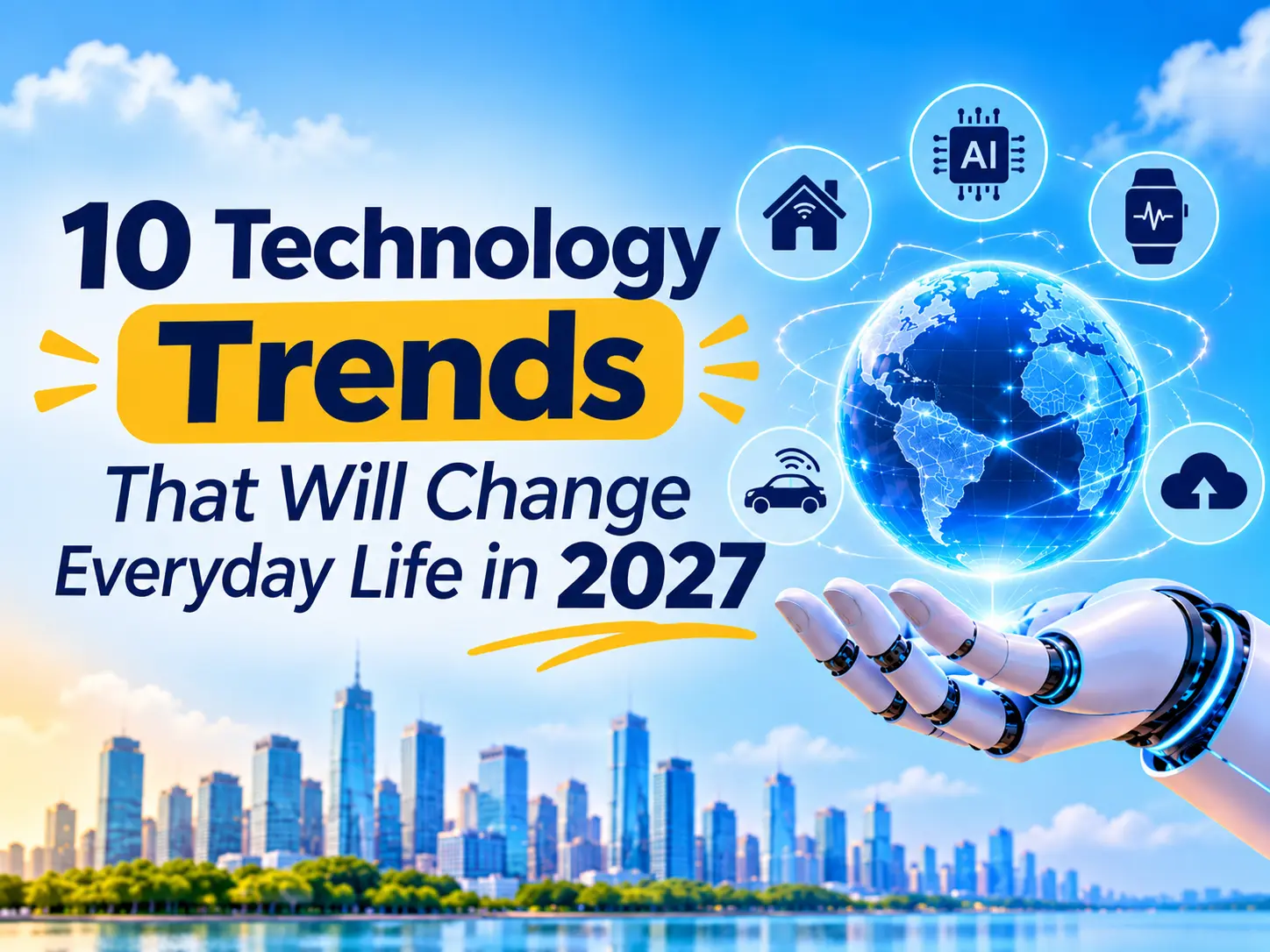
Technology is evolving faster than ever. From artificial intelligence and smart homes to wearable devices and autonomous systems, innovations that once seemed like science fiction are gradually becoming part of our daily routines.
As we move toward 2027, technology will play an even bigger role in how we work, communicate, shop, travel, learn, and manage our personal lives. Artificial intelligence will become more integrated into everyday applications, smart devices will become more connected, and digital experiences will continue to transform how people interact with the world.
But what technologies will make the biggest difference?
In this article, we explore 10 technology trends that will change everyday life in 2027, including how they work, where they are being used, and what they could mean for the future.
1. Artificial Intelligence Will Become Part of Everyday Life
Artificial intelligence (AI) is already used in smartphones, search engines, digital assistants, photo editing applications, and online shopping platforms. However, in 2027, AI is expected to become even more deeply integrated into everyday activities.
Instead of simply responding to questions, AI-powered applications will increasingly help users complete tasks, organize information, generate content, and automate repetitive work.
For example, AI assistants may help people:
- Schedule meetings and manage daily tasks.
- Write emails and summarize long documents.
- Plan trips and recommend places to visit.
- Create presentations and edit images.
- Analyze information and support everyday decisions.
AI tools are also becoming useful in education, healthcare administration, customer service, and business operations.
How it will change everyday life: People will be able to complete many digital tasks faster, reduce repetitive work, and spend more time on activities that require creativity and human judgment.
2. AI Agents Will Automate More Daily Tasks
AI agents are one of the most interesting developments in artificial intelligence.
Unlike traditional chatbots that mainly respond to instructions, AI agents can work toward specific goals by planning steps, using digital tools, and carrying out tasks with varying levels of human supervision.
Imagine asking an AI agent to organize a business trip. It could help compare flights, research hotels, prepare an itinerary, and organize important travel information.
Other possible applications include:
- Managing customer support requests.
- Organizing business workflows.
- Researching information across multiple websites.
- Managing personal schedules.
- Automating repetitive office tasks.
Businesses are particularly interested in AI agents because they could help improve productivity and reduce time spent on routine operations.
However, human supervision will remain important, especially when agents handle payments, personal information, or important business decisions.
How it will change everyday life: People may increasingly delegate routine digital tasks to AI agents instead of completing every step manually.
3. Smart Homes Will Become More Intelligent
Smart home technology is gradually changing how people manage their living spaces. Devices such as smart lights, security cameras, thermostats, smart speakers, and connected appliances already allow homeowners to control different parts of their homes remotely.
In 2027, smarter automation and AI integration could make these systems more personalized and convenient.
For example, a smart home system may be able to:
- Adjust lighting based on daily routines.
- Automatically regulate room temperature.
- Detect unusual activity around the property.
- Help monitor electricity consumption.
- Control compatible appliances through voice commands.
Connected home devices are also becoming more interoperable through technologies such as Matter, which is designed to improve communication between compatible smart home products.
However, users should consider device security, data privacy, and compatibility before investing in smart home equipment.
How it will change everyday life: Managing household devices could become easier, more energy-efficient, and more automated.
4. Wearable Technology Will Go Beyond Fitness Tracking
Smartwatches and fitness bands have already made wearable technology popular. Millions of people use these devices to monitor physical activity, track sleep, measure heart rate, and receive smartphone notifications.
The next stage of wearable technology will focus on more advanced sensors, personalized insights, and closer integration with digital health platforms.
Future wearable devices may offer improvements in:
- Sleep monitoring and analysis.
- Activity and fitness tracking.
- Heart rate monitoring.
- Personalized wellness insights.
- Smartphone-free communication.
- Health data integration.
Smart rings and other compact wearable devices are also gaining attention because they offer health and activity tracking in smaller designs.
Although wearable technology can provide useful information, it should not replace professional medical advice or clinical testing.
How it will change everyday life: People will have more convenient ways to monitor their activity, understand their daily habits, and make informed lifestyle decisions.
5. Extended Reality Will Transform Digital Experiences
Extended Reality (XR) is an umbrella term that includes Virtual Reality (VR), Augmented Reality (AR), and Mixed Reality (MR).
These technologies combine digital content with physical environments or create entirely virtual experiences.
While VR is already popular in gaming and entertainment, AR and MR have potential applications across education, shopping, healthcare training, and professional work.
For example:
- Students could explore interactive 3D learning environments.
- Shoppers could preview furniture in their homes before purchasing.
- Technicians could view digital instructions while repairing equipment.
- Architects could present interactive building designs.
- Remote teams could collaborate in immersive virtual environments.
As headsets, smart glasses, and spatial computing platforms evolve, these experiences could become more accessible.
However, high device costs, comfort, battery life, and limited applications remain important challenges.
How it will change everyday life: Digital information could become more interactive, allowing people to learn, shop, communicate, and work in new ways.
6. Electric Vehicles and Smarter Transportation Will Grow
The transportation industry is experiencing a major technological transformation.
Electric vehicles (EVs), improved battery technology, connected car systems, and advanced driver assistance features are changing how people travel.
In 2027, electric mobility is expected to remain an important technology trend as manufacturers continue improving vehicle efficiency, charging infrastructure, and battery performance.
Some developments to watch include:
- More affordable electric vehicle models.
- Improvements in battery charging speeds.
- Better vehicle energy management.
- Advanced driver assistance systems.
- Smarter traffic and navigation systems.
- Improved public charging infrastructure.
Autonomous driving technology is also developing, although fully self-driving vehicles will not be equally available everywhere.
In countries such as India, electric two-wheelers, electric three-wheelers, and electric cars could play an important role in the growth of electric mobility.
How it will change everyday life: Transportation could gradually become cleaner, more connected, and more efficient.
7. Cybersecurity Will Become More Important Than Ever
As people depend more heavily on digital services, protecting personal information will become increasingly important.
Online banking, digital payments, cloud storage, social media, smart home devices, and AI applications all involve sensitive information.
At the same time, cybercriminals are using increasingly sophisticated techniques, including phishing, identity theft, social engineering, and AI-generated impersonation.
In 2027, cybersecurity technologies and digital safety practices will remain essential.
Some important developments include:
- Passkeys replacing traditional passwords in more services.
- Wider adoption of multi-factor authentication.
- AI-powered threat detection.
- Improved identity verification.
- Better protection for connected devices.
- More advanced fraud detection systems.
Users can also improve their digital security by using unique passwords, enabling two-factor authentication, avoiding suspicious links, and keeping their devices updated.
How it will change everyday life: Digital security will become an essential part of everyday activities rather than something people only consider after a cyberattack.
8. 6G Research Will Shape the Future of Connectivity
5G technology has improved mobile connectivity by offering higher speeds, lower latency, and support for more connected devices.
However, the next generation of wireless communication, known as 6G, is already an important area of research and development.
6G is expected to explore advanced communication technologies, improved network intelligence, and new ways to connect physical and digital environments.
Potential applications include:
- More advanced connected transportation.
- Immersive communication experiences.
- Smarter industrial automation.
- Improved real-time connectivity.
- Advanced sensor and device networks.
It is important to understand that 6G is still under development. Widespread commercial deployment is not expected to be an everyday reality in 2027.
Nevertheless, research taking place now could influence the future of mobile networks.
How it will change everyday life: Although most people may not use 6G in 2027, developments in next-generation connectivity could shape future communication, entertainment, and connected services.
9. Robotics Will Become More Common in Homes and Businesses
Robots are no longer limited to manufacturing facilities and research laboratories.
Today, robots are being used in warehouses, hospitals, agriculture, restaurants, and logistics operations. Domestic robots, such as robotic vacuum cleaners, are also becoming increasingly common.
In the coming years, improvements in AI, computer vision, sensors, and robotics hardware could make robots more capable of handling complex tasks.
Potential applications include:
- Cleaning and household assistance.
- Warehouse inventory management.
- Agricultural monitoring.
- Healthcare and rehabilitation support.
- Delivery and logistics operations.
- Industrial inspection and maintenance.
Humanoid robots are attracting considerable attention, but widespread household adoption remains uncertain because of cost, reliability, and safety challenges.
How it will change everyday life: Robots could take over more repetitive or physically demanding tasks, helping businesses improve efficiency and making certain household activities easier.
10. Digital Payments and Digital Identity Will Continue to Evolve
Digital payments have transformed how people purchase products, transfer money, and manage finances.
Mobile wallets, contactless payments, QR codes, and instant payment systems have made financial transactions more convenient.
In 2027, digital financial services are likely to continue evolving through better security, improved payment experiences, and increased integration with digital platforms.
Some developments to watch include:
- More widespread use of contactless payments.
- Improved biometric authentication.
- Smarter fraud detection.
- Greater adoption of digital identity systems.
- More convenient cross-platform payment experiences.
- Improved financial management applications.
In India, UPI has already made instant digital payments a familiar part of everyday life. Continued innovation in payment infrastructure could make digital transactions even more accessible.
However, users should remain careful about fraudulent QR codes, fake payment requests, and unauthorized transactions.
How it will change everyday life: Paying for products, transferring money, and accessing digital services could become faster and more convenient.
Challenges That Could Come With These Technology Trends
Although emerging technologies offer exciting opportunities, they also introduce challenges that individuals, businesses, and governments must address.
Some important concerns include:
1. Data privacy: AI applications, wearable devices, and smart home products can collect large amounts of personal information.
2. Cybersecurity risks: Increasing digital connectivity creates more opportunities for cyberattacks and online fraud.
3. Job market changes: Automation could change the skills required in many industries and reduce demand for certain repetitive tasks.
4. Technology costs: Advanced devices and services may remain expensive, limiting access for some people.
5. Digital dependency: Greater reliance on connected devices could create problems when networks, applications, or digital services stop working.
To benefit from technological progress, users need to understand both the advantages and the potential risks.
Conclusion: What Will Everyday Life Look Like in 2027?
Technology in 2027 will be shaped by smarter software, connected devices, artificial intelligence, automation, and improved digital infrastructure.
AI assistants and agents could help people complete everyday tasks, wearable devices may provide more personalized insights, and smart homes could become increasingly automated. Electric mobility, cybersecurity, robotics, and digital payments will also continue influencing how people live and work.
However, not every emerging technology will become mainstream overnight. Some innovations will develop gradually, while others may take several years before becoming affordable and widely accessible.
The most important thing is to understand these developments and learn how to use technology responsibly.
One thing is certain: the future of technology is not just about creating smarter devices. It is about making everyday life more connected, convenient, productive, and secure.